One of the first things to learn when starting out with art:
“Almost every physical object can be conceptualized as a simple box form before complexity and details are overlaid.”
— Chris Solarski, Drawing Basics and Video Game Art (2012, p. 27)
A box is already a 3D shape. For game art — especially 2D and pixel art — we start one step earlier, with 2D forms and their meanings. Three primitives carry most of the visual language: the dot, the square, the triangle.
The Dot / Circle
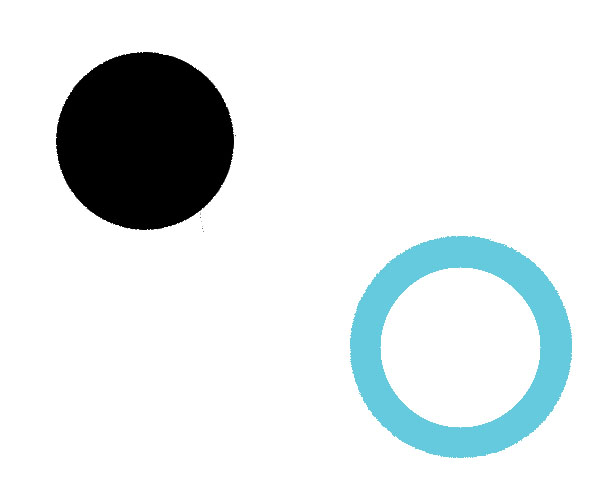
“A dot might seem to be an unassuming little thing, the first mark on the pristine sheet of paper. In this case, the dot is a beginning. But see what just happened there? The dot, an essential component in the structure of a sentence, closed it, making it a symbol of ending.”
— Adele Nozedar, The Element Encyclopedia of Secret Signs and Symbols (2010, p. 20)
A little too philosophical? Maybe. But the dot is what our work is all about — once we start calling it a pixel. Scale it up beyond a single pixel and you have a round form that can be anything in a game world: a ball, a bullet, a head, a coin, the character itself.
Visual associations:
- Soft, organic, alive — eyes, fruit, creatures
- Movement, motion — coins spinning, bullets travelling
- Wholeness — UI badges, health orbs, planet markers
The Square / Rectangle
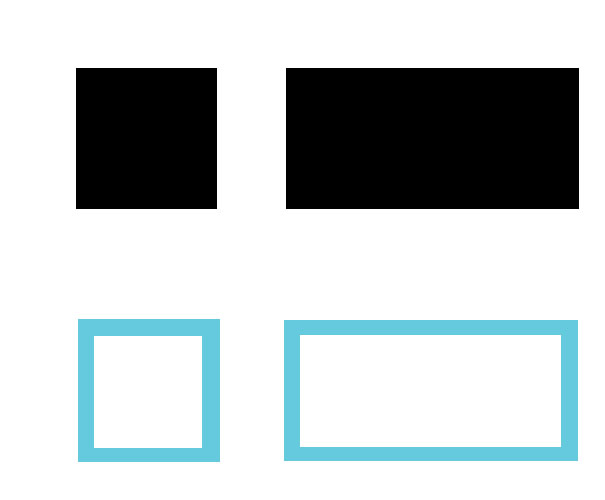
“Said to be the first shape invented by Man, the square represents the created Universe as opposed to the spiritual dimensions depicted by circle. (…) The square gives man a safe, static reference point, and a stable, unmoving shape as opposed to the circle.”
— Adele Nozedar (2010, p. 22)
“Stable” is nice, but as a game designer you see something more useful: a box, a crate, a frame. The rectangle is the 2D equivalent of a box — and every physical object can be conceptualized as a rectangle first, just like Solarski’s box rule.
Visual associations:
- Built, man-made, architectural — buildings, crates, doors, frames
- Tiles — the entire grid-based world of platformers and roguelikes
- UI — windows, panels, buttons
The Triangle
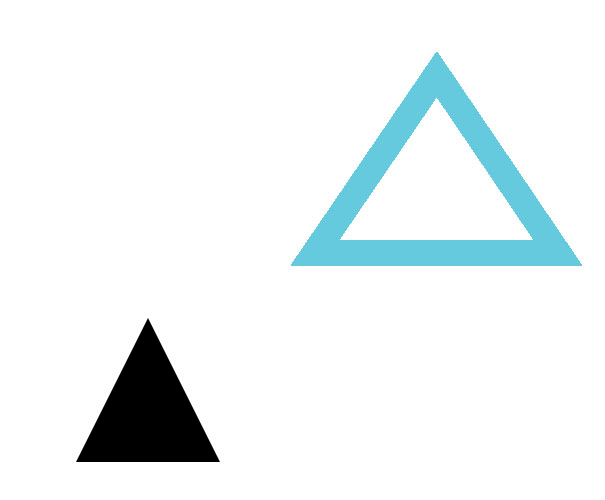
“The triangle shares all the symbolic significance of the number 3. (…) Triangles appear in lots of different signs and symbols. In ancient times, the triangle was considered synonymous with light, and the meanings of the triangle vary according to which way up it is.”
— Adele Nozedar (2010, p. 23)
Signs and symbols — exactly. Triangles are visual punctuation. In a 2D game, a triangle can be a roof, a mountain peak, a warning sign, an arrow, a play button, the nose of a face. Pointed up: aspirational, stable, growing. Pointed down: unstable, falling, threatening.
Visual associations:
- Direction — arrows, indicators, “go here” UI cues
- Danger / warning — hazard signs, sharp edges
- Hierarchy — mountains, pyramids, kings on thrones
Why these three forms matter
Strip any character, prop, or environment down to silhouette and you’ll find one of these primitives dominating. Stardew Valley villagers: rectangles with circle heads. Hollow Knight enemies: aggressive triangles. Slime in any RPG: a single rounded dot.
When you start a sprite or character design, block in the shapes first. Then refine. Anyone trying to start with details before the overall silhouette ends up with a fiddly mess that doesn’t read at any size.
Up next: take these forms into practice with the First 2D Character Tutorial.